DASC conference logo Aeronautics Institute of Technology logo LABGETA Air Traffic Management Laboratory logo
45th DASC · Best Student Paper Award Finalist · Paper ID 276

Stochastic Strategic Demand–Capacity Balancing Using Model-Free Reinforcement Learning

Lucas Orbolato Carvalho · Mayara Condé Rocha Murça

Aeronautics Institute of Technology (ITA) · São José dos Campos, Brazil

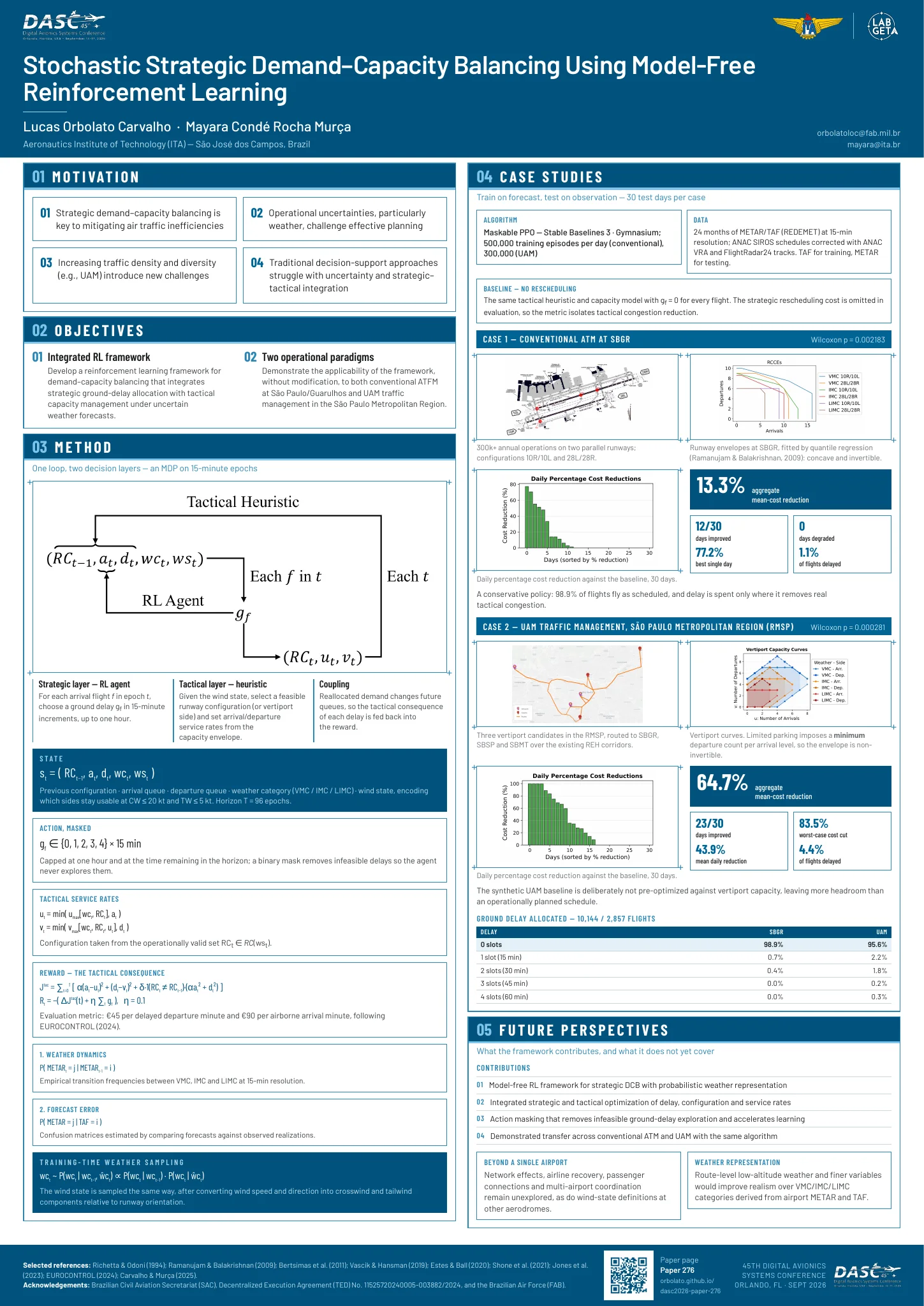
The RL policy reduced aggregate tactical congestion cost by 13.3% at SBGR and 64.7% in the UAM case study while delaying only 1.1% and 4.4% of flights, respectively.

At a glance

A model-free reinforcement learning framework allocates strategic ground delays under weather uncertainty while accounting for the downstream tactical capacity consequences.

13.3%aggregate mean-cost reduction in conventional ATM at SBGR
64.7%aggregate mean-cost reduction in UAM; 43.9% mean daily percentage reduction
30test days per case study
1.1% / 4.4%of flights delayed in conventional ATM / UAM

Abstract

Strategic demand-capacity balancing is essential for mitigating inefficiencies in air traffic operations, particularly under dynamic and uncertain weather conditions. This work proposes a stochastic demand-capacity balancing approach based on reinforcement learning, in which an agent allocates ground delays to individual flights using traffic demand and weather forecasts. The method is evaluated using real-world data for São Paulo/Guarulhos International Airport (SBGR), with performance assessed against observed weather conditions. An additional case study illustrates the applicability of the approach to Urban Air Mobility (UAM) operations, showing that the same algorithm can support traffic flow management in both conventional and emerging air traffic environments. The results highlight the potential of reinforcement learning to support adaptive, uncertainty-aware demand-capacity balancing in future Air Traffic Management (ATM) systems.
Method in brief

Strategic layer

Maskable PPO assigns per-flight ground delays in 15-minute increments, capped at one hour and by the remaining planning horizon.

MDP formulation

The state captures the previous operational configuration, traffic queues, weather category and wind state; the action is a per-flight ground delay, and the reward links strategic delay decisions to their downstream tactical congestion consequences.

Weather uncertainty

Training combines empirical weather dynamics with forecast-error information derived from TAF and METAR records.

Tactical layer

Reallocated demand is evaluated against runway or vertiport capacity constraints, allowing the strategic policy to internalize tactical congestion effects.

Evaluation

Conventional ATM is evaluated at SBGR using real-world traffic and weather data; the same learning framework is also examined in a UAM case study for the São Paulo Metropolitan Region.

Results

Conventional ATM at SBGR

Across 30 test days, the policy reduced aggregate mean tactical cost by 13.3%, improved 12 of 30 days, and achieved a maximum daily reduction of 77.2%. Only 1.1% of flights received strategic ground delay.

UAM case study

Across 30 test days, the policy reduced aggregate mean tactical cost by 64.7%, with a 43.9% mean daily percentage reduction and improvements on 23 of 30 days. Strategic delay was applied to 4.4% of flights. The synthetic UAM baseline was deliberately not pre-optimized against vertiport capacity, leaving more headroom than an operationally planned schedule.

Related work underlying this study

The present DASC study builds on our previous work in tactical runway-capacity management and UAM network planning.

Poster

Click the preview to open the full-resolution A0 poster.

DASC 2026 poster preview for the paper

Full paper

The full conference paper is available.

The PDF presented at DASC 2026 is available here. This page can be updated with the official IEEE Xplore link once the proceedings version is published.

View paper

Conference

45th Digital Avionics Systems Conference (DASC)
Orlando, Florida · September 13–17, 2026 · Paper ID 276

Best Student Paper Award finalist.